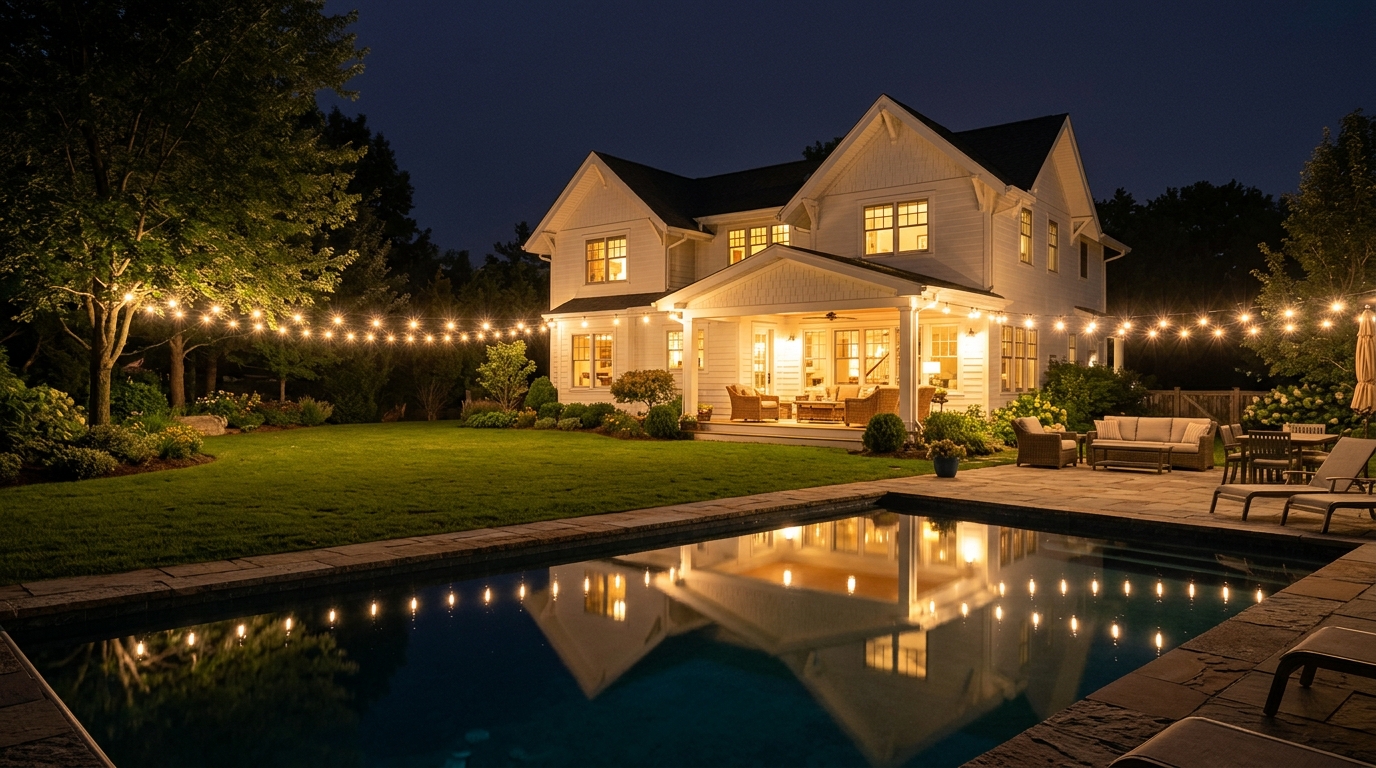
Why does one yard feel like a boutique hotel at nine o’clock while the one next door feels like a parking lot? The best backyard lighting ideas have little to do with how many fixtures you buy and almost everything to do with where the light lands.
Most backyards are lit by a single porch fixture that does two jobs badly. It floods the back door, blinds anyone who steps outside, and leaves everything past the first few feet in darkness. The result is a yard that disappears at sunset, no matter how much was spent on the furniture and plants. More and more homeowners are moving toward layered, low-glare lighting that treats the garden like another room of the house. It makes sense, because evenings are when most of us actually have time to sit outside.
This guide gathers twenty backyard lighting ideas that work for patios, pergolas, pools, paths and compact city plots alike. Each one covers the design move, the reason it works, and a practical way to copy it at home, often without any rewiring. You will find plug-in, solar and low-voltage options along the way, plus honest notes about where an idea falls short. Hold on until idea 17, where one small placement rule fixes the glare that spoils most outdoor lighting plans.
1. Wash Stone Walls and Pillars With Warm Backyard Lighting
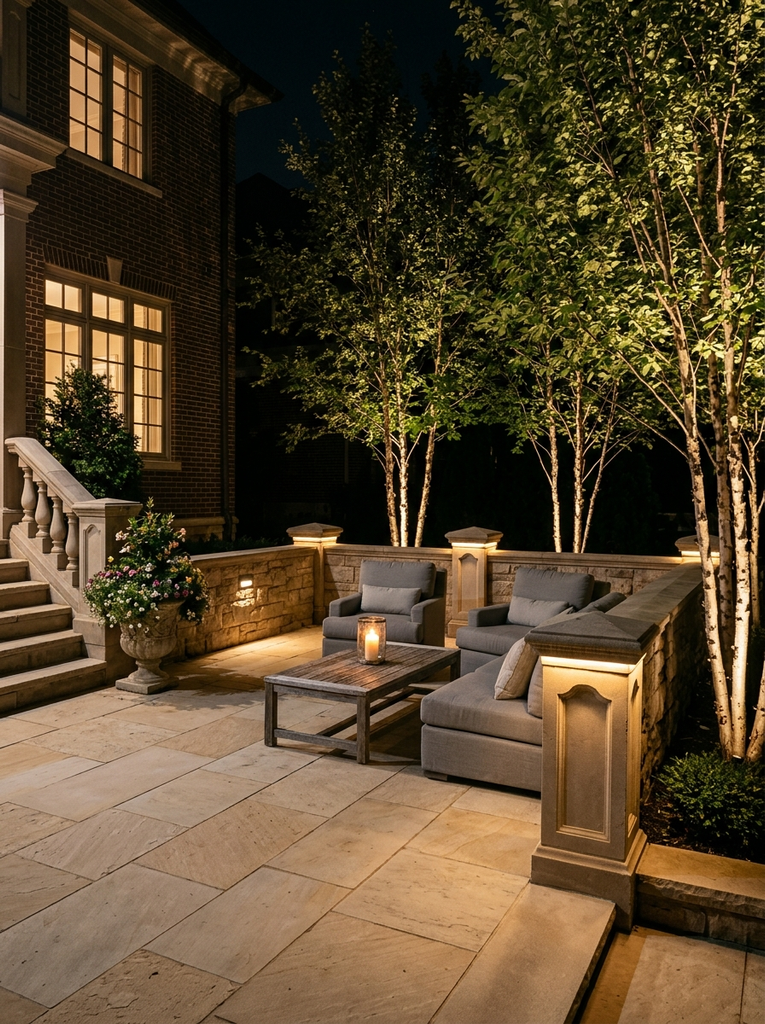
Stone and brick are the best surfaces in a yard to light, because their texture throws back a soft glow that fills the whole space without a single bright bulb. Small recessed lights set into the face of a low retaining wall, plus a cap light tucked under the top slab of a pillar, create a gentle scalloped wash that outlines the patio edge. That outline matters more than people expect, since the eye reads a lit boundary as a room with walls. Keep every fixture at the same warm color temperature, around 2700K, so the pale pavers, the golden stone and a flickering candle lantern all read as one family. If a full wall of fixtures is not in the budget, start with just the two pillars flanking the seating area and add the rest later. Aim for a rhythmic spacing of roughly one fixture per wall section rather than a continuous string of dots.
2. Mark Every Step With a Tiny Recessed Light
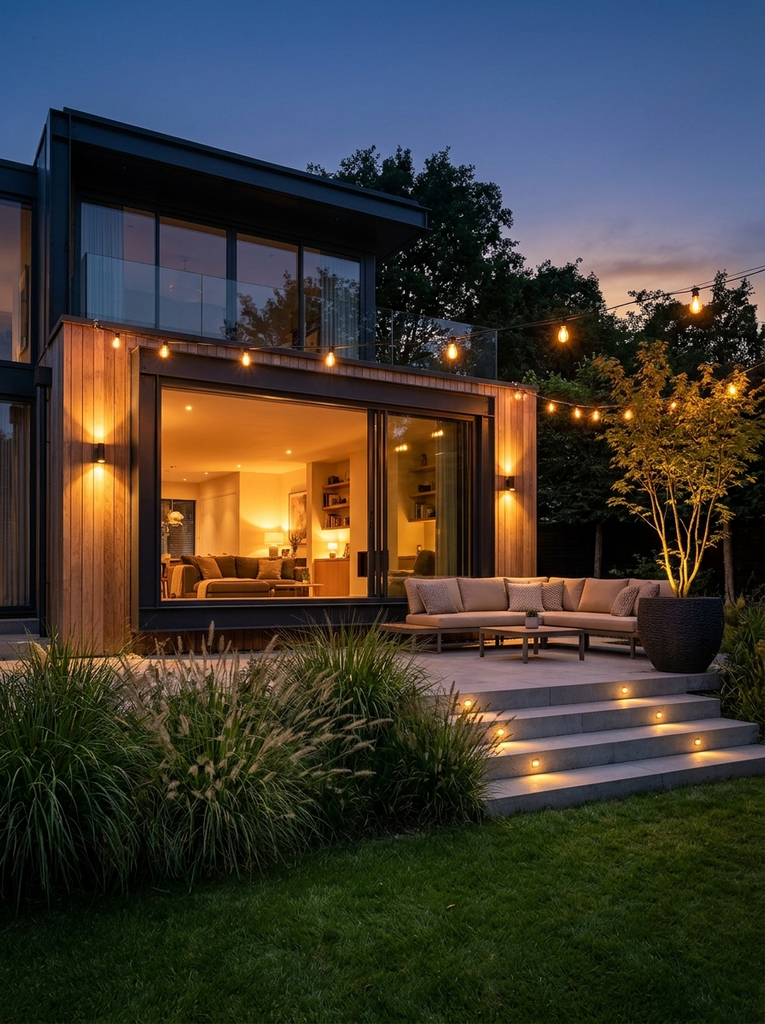
Steps are where outdoor missteps happen, so a tiny light in each riser is one of the most useful backyard lighting ideas you can borrow. A small round fixture set into the stone face casts a thin pool of light across the tread below, which makes every edge visible without any glare in your eyes. The effect works best when the fixtures are evenly spaced and all the same size, giving the steps a clean, architectural line. Add a pair of wall lanterns beside the doors and a loose strand of bulbs overhead, and the transition from indoors to outdoors feels continuous. A multi-stem tree in a large planter, lit gently from below, softens the hard geometry of the stairs. If your steps are already built, surface-mounted low-voltage riser lights can be fixed from the side, so no demolition is needed.
3. Hang Cafe Lights Over a Fire Pit Lounge
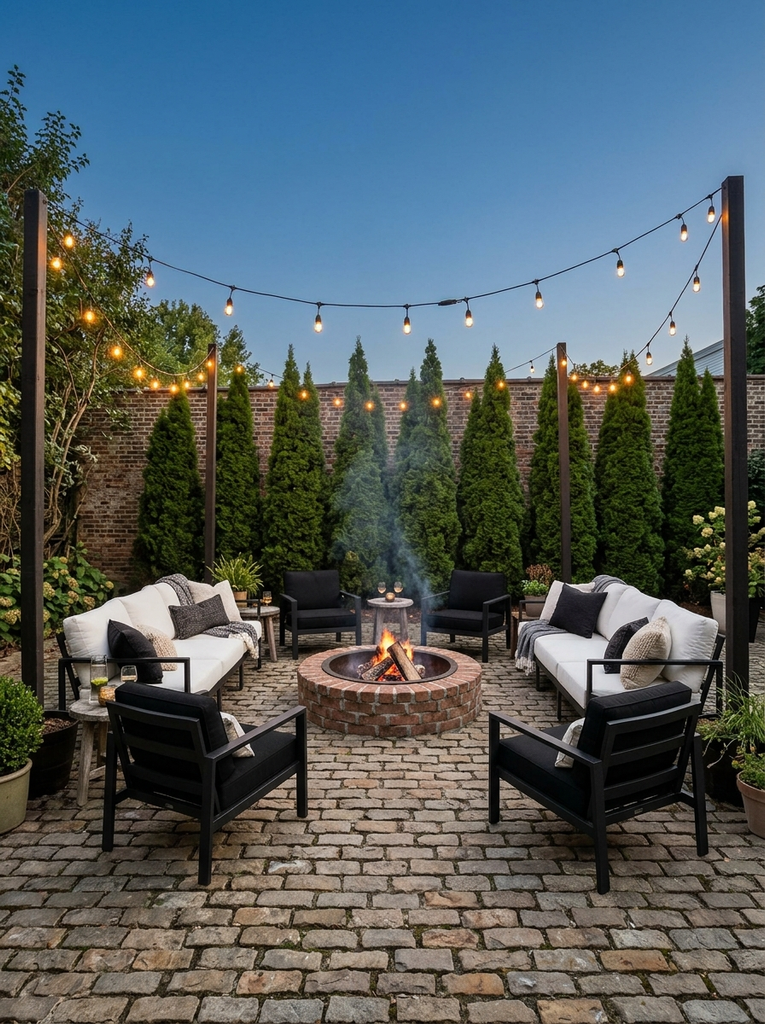
A fire pit gives you warmth and a focal point, but a ring of overhead bulbs is what turns it into a room. Cafe-style string lights hung in two or three long swags between posts define the ceiling of the lounge, even though nothing is actually above you. Hang them high enough to clear the tallest guest, and let each swag sag a little, because a taut line looks like a wire while a gentle curve looks like a decision. The warm bulbs also balance the cool tones of white cushions and black metal frames, which can feel stark after dusk. Columnar evergreens along the brick wall act as a green backdrop, so the light has something soft to bounce off. If posts are not yet installed, sturdy planters or fence posts can anchor the lines just as well.
4. Cover a Patio Ceiling With a Grid of Warm Bulbs
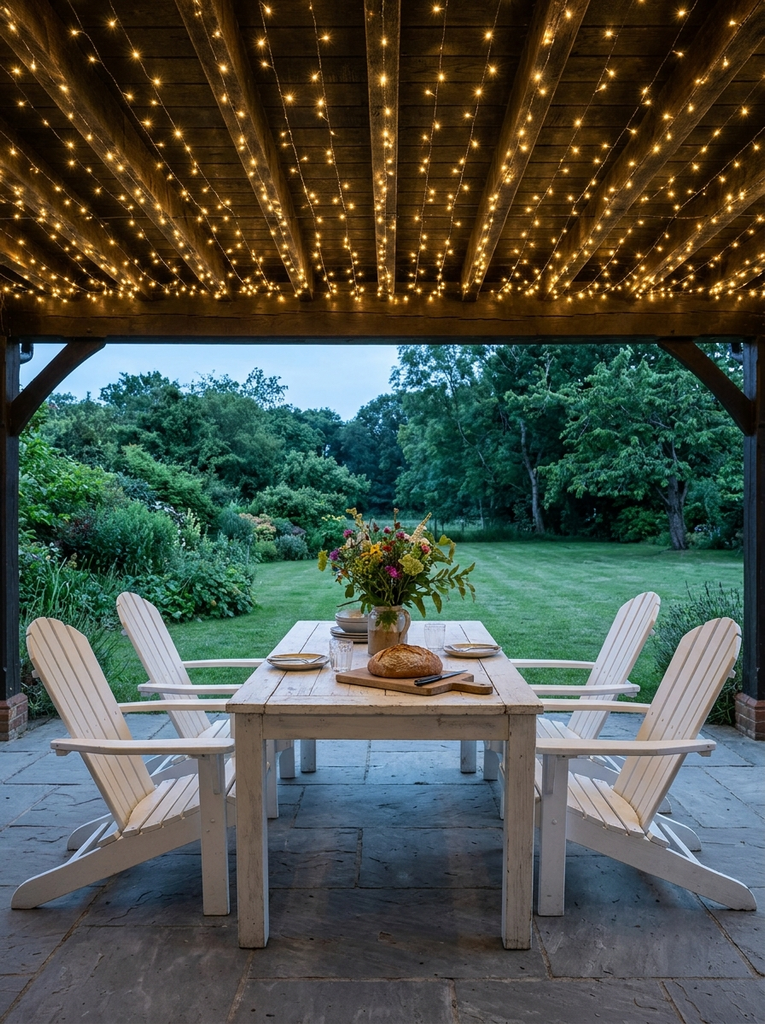
When a patio has a roof, the ceiling becomes the best place to hang light, and of all the backyard lighting ideas for covered spaces, a full grid of strands is the most dramatic. Run the strands in parallel lines across the beams, keeping each one a consistent distance from the next so the bulbs read as a deliberate pattern rather than a tangle. A dark ceiling is your friend here, since it makes small bulbs glow like stars and keeps the light from bouncing back into your eyes. I once strung a covered area with a single sparse line, and it looked like a mistake until I added more rows, because the density is what makes the effect feel generous. White Adirondack-style chairs and a pale table pick up the glow beautifully, so the furniture appears to float against the dark lawn. Choose dimmable bulbs so dinner can be bright and the hour after it can be low.
5. Light Moving Water From Inside the Steps
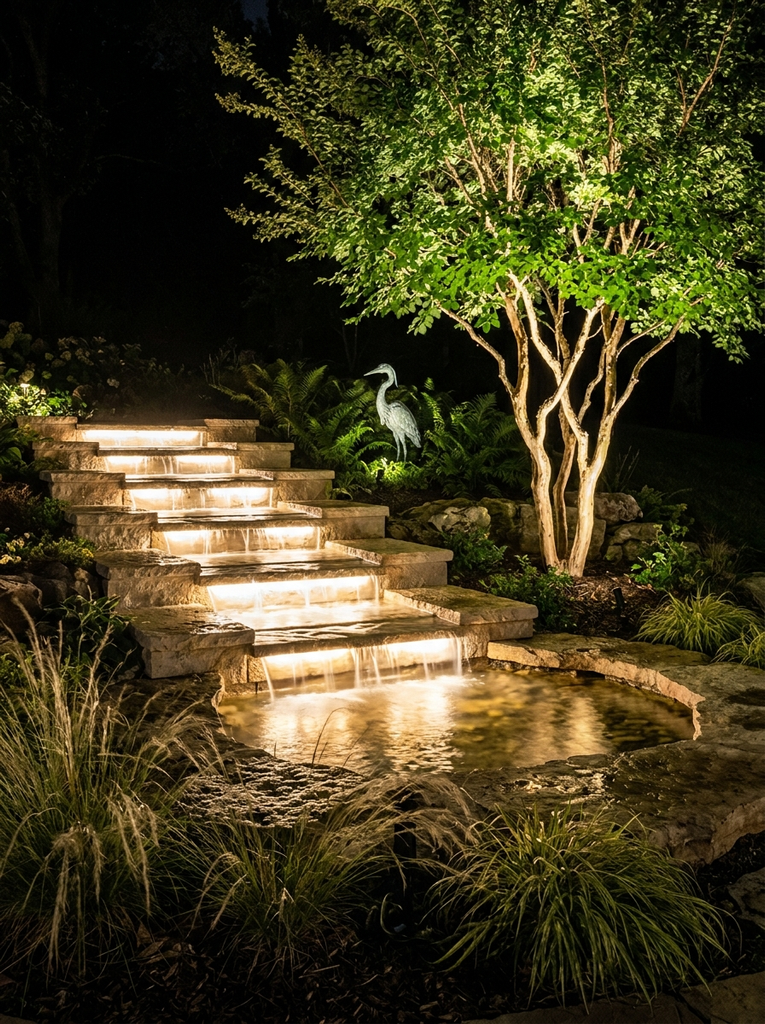
Water catches light better than almost anything else in a garden, so a stepped water feature deserves its own plan among your backyard lighting ideas. Slim fixtures tucked under each stone lip make every ledge glow from within, and the thin sheets of water spilling over turn that glow into movement. Surround it with darkness on purpose, since the contrast is what makes the water sparkle and extra lights would only flatten it. Choose a multi-stem tree nearby and aim one narrow beam up through its trunks, so the pale bark and fresh green leaves become a second glowing feature. A small sculpture in the background, lit softly from the side, gives the eye a place to rest at the end of the view. If you do not have a water feature, the same idea works on a staircase of pale stone with a light under each nosing.
6. Line a Dark Fence With Lantern Sconces
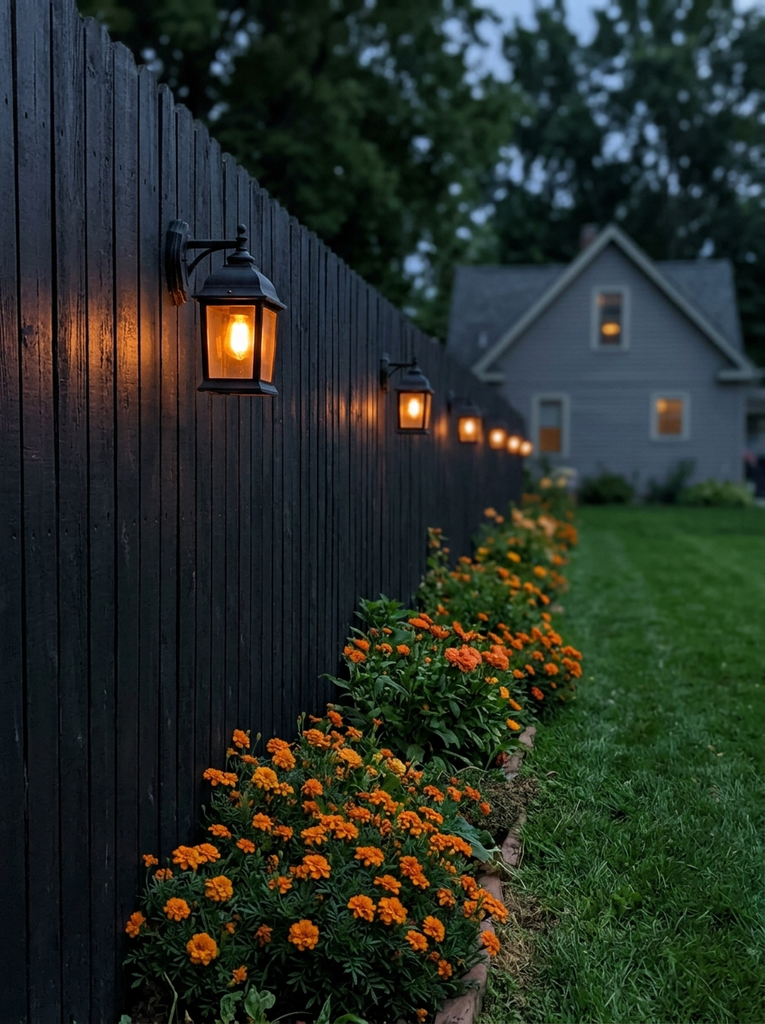
A black fence can feel like a wall of nothing after dark, and a row of lantern sconces is one of those backyard lighting ideas that fixes it at once. Mounting the lanterns at an even interval, roughly at eye level, creates a rhythm that pulls the eye down the length of the yard and makes a narrow space feel longer. The glass and black-metal housings add a traditional touch, while the amber glow warms the dark boards behind them. Marigolds and other orange blooms planted below echo the lantern color, which ties plant and light into a single palette. Solar versions are an easy way to test the idea before committing to wiring, though they tend to be dimmer, so space them a little closer together. Keep the beds in front low so the fixtures stay visible from the lawn.
7. Hang Woven Globes From a Tree Canopy
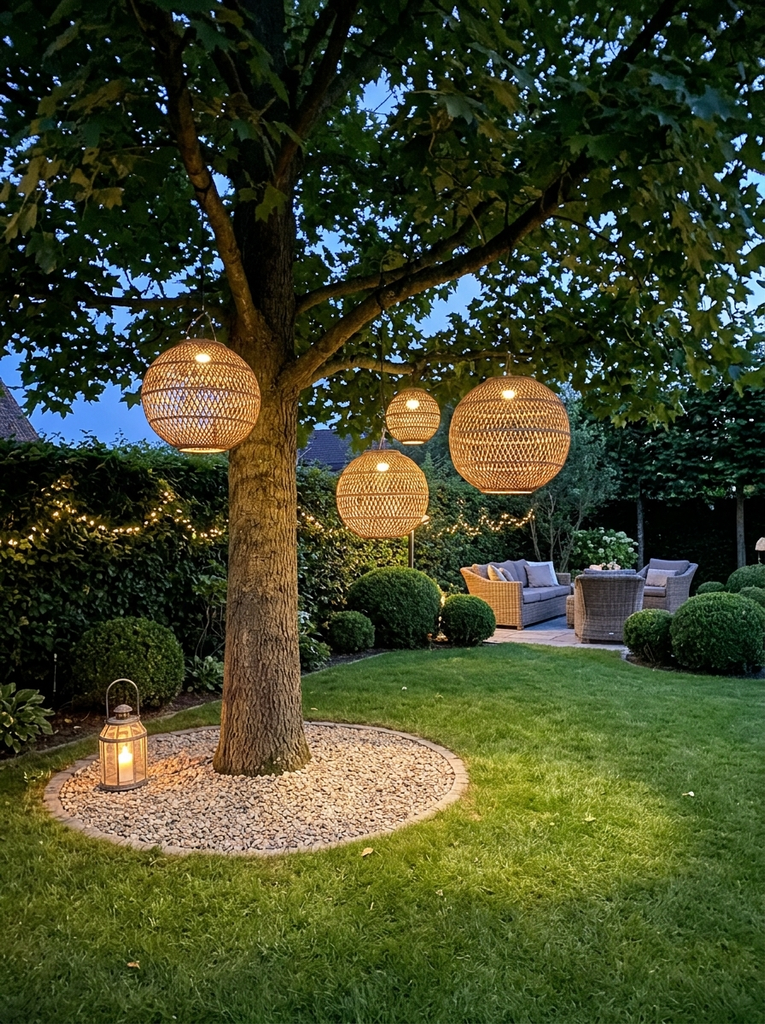
A mature tree is a free ceiling, and a few woven globes hung at different heights turn it into a chandelier. Natural rattan or wicker shades diffuse the bulb inside into a soft pattern, so you get glow without glare. Vary the drop of each globe and avoid hanging them in a straight line, because staggered heights read as organic rather than staged. A faint strand of mini bulbs tracing the hedge behind lifts the whole scene from background to backdrop. Rounded boxwoods and a ring of pale gravel around the trunk create a tidy base, so the canopy has something grounded to balance against. Place a seating group further back, and the tree becomes the centerpiece you look toward rather than sit under.
8. Guide Gravel Paths With Low Bollard Lights
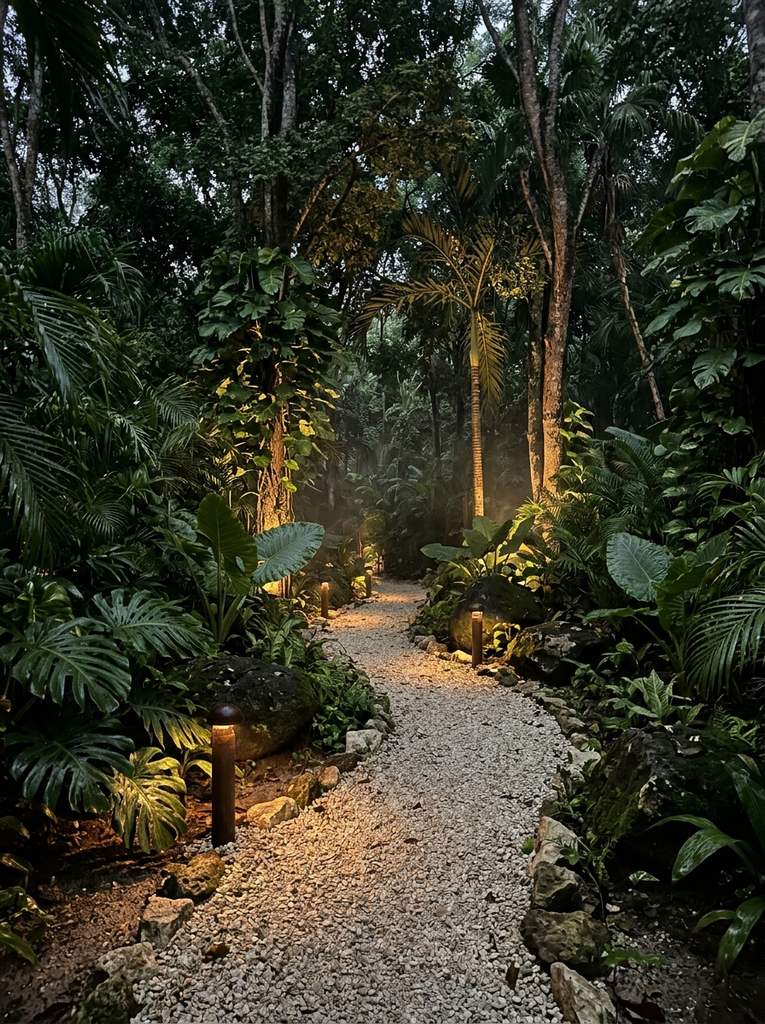
Among practical backyard lighting ideas, path lights come first, and they work best when the light comes from the side and below, so the walker sees the ground rather than a glaring bulb. Short bollards placed on alternating sides of the walk, with generous gaps between them, create stepping-stone pools of light that keep the route obvious. Gravel helps here because its rough surface scatters the beam into a soft, even glow. Foliage near each fixture picks up a little spill, which gives the path depth, with leaves glowing close by and fading to black beyond. Choose bollards with shielded tops so the bulb is never visible from the path. For a long run, low-voltage systems are gentler on the budget and safer than line voltage, and the cable can be buried in a shallow trench along the edge.
9. Mix Caged Bulbs and Amber Lantern Posts for a Party Table
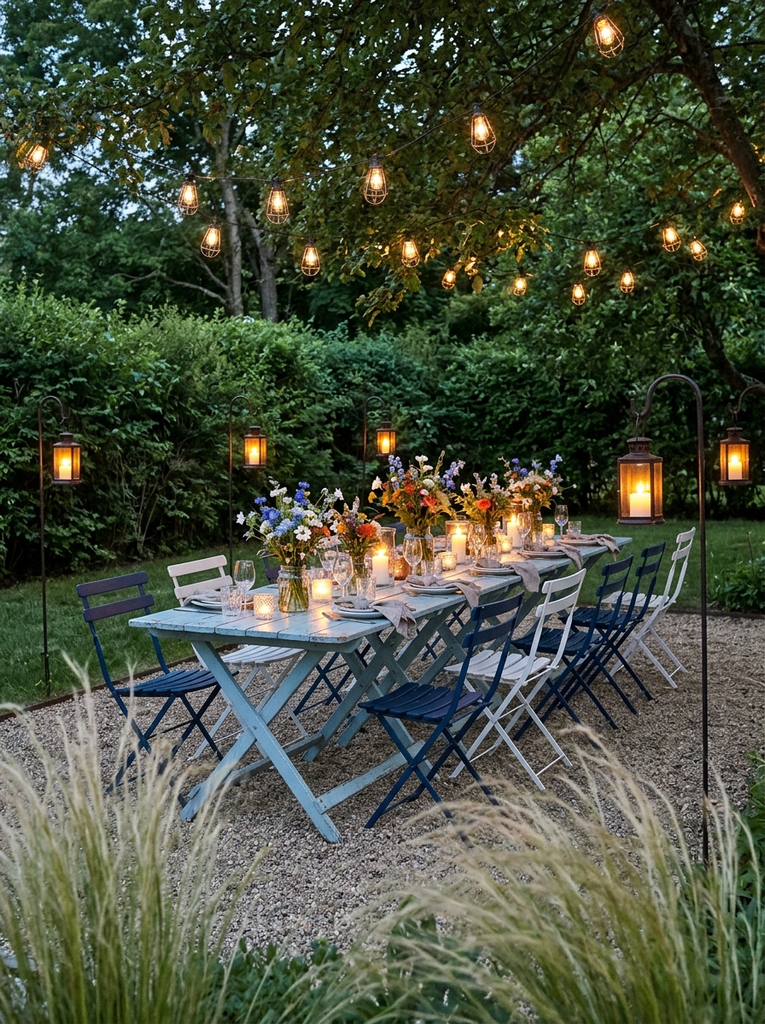
A dining table in a gravel courtyard feels festive with nothing more than two kinds of light at two different heights. Overhead, a loose line of caged bulbs gives a vintage, industrial sparkle, while slim amber lantern posts at the table edge add a warm column of light near shoulder height. Putting light at more than one level is the easiest of all backyard lighting ideas, since it stops the space from feeling lit by a single source. The blue folding table and mismatched chairs prove you do not need matching furniture when the lighting is cohesive. A few votives and a jar of cut flowers put the brightest points of light at hand height, where conversation actually happens. Gravel underfoot makes setup easy, because stakes and bases push straight into it.
10. Run Hidden LED Tape Along Eaves and Patio Edges
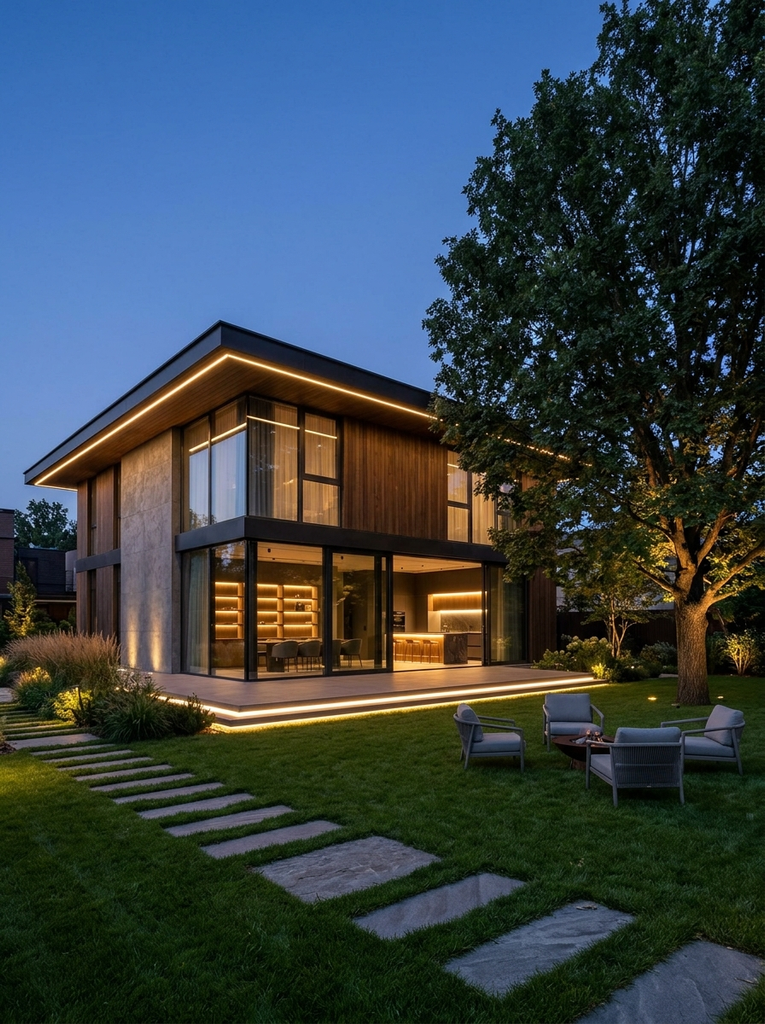
Hidden LED tape is the modern way to light a contemporary patio, and among backyard lighting ideas it is the one that looks most like architecture, because only the glow shows. Tucked under the roof overhang, it washes the ceiling and shelves with a warm, even light, while a second line along the paver edge outlines the terrace like a runway. The key is to hide the source completely, so no strip or fixture is visible from where you sit. Choose a warm white strip and keep the same color temperature throughout, since a mismatched strip looks cheap right next to wood tones. A few stepping stones crossing the lawn, each separated by a clean band of grass, carry that linear logic into the garden. Use weatherproof, outdoor-rated tape with a driver mounted somewhere dry, and have an electrician check the connection to the mains.
11. Uplight Multi-Stem Trees at the Front of the House
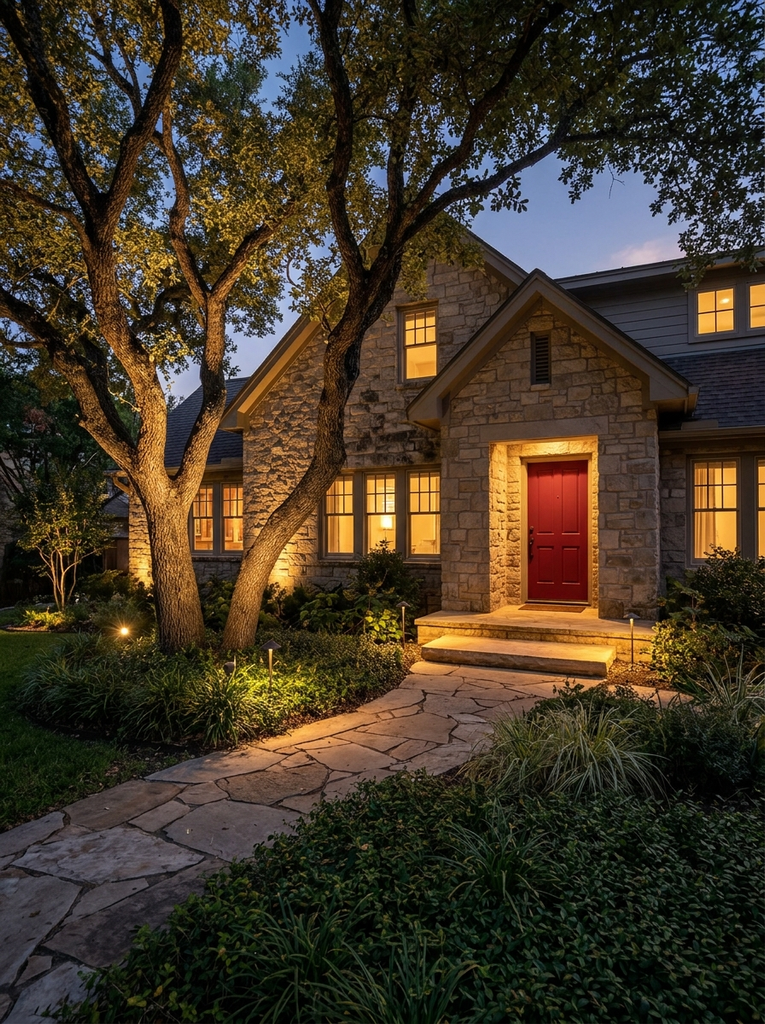
Lighting the trees in front of a house does more for curb appeal than lighting the house itself. A single low-voltage spot at the base of a multi-stem tree, angled up through the trunks, picks out the bark and lights the underside of the leaves, so the canopy glows against a deep blue evening sky. Place one on each side of the walk and the entrance gets symmetrical framing without a single fixture on the facade. Add a soft path light low in the groundcover and a small step light at the porch, and the route to the door becomes obvious. Dusk is the best time to judge the result, because the sky still holds some color and the contrast is easy to read. Keep the beams narrow and aimed upward so they never shine into the windows.
12. Run Bulbs Along Poles and Between Trunks
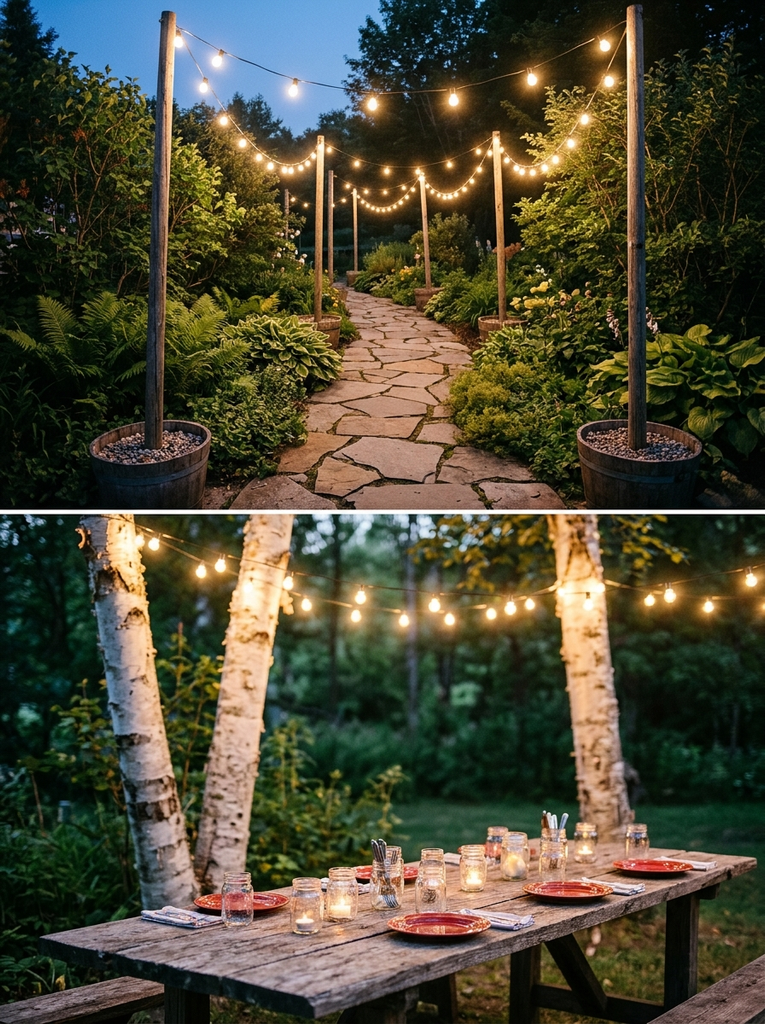
Poles are the easiest way to create a lit ceiling where there is no structure, and they work over a path as well as a dining table. Wooden posts set in buckets or weighted bases carry a strand over a walkway, turning an ordinary route into a softly lit tunnel. On a rustic table, tie the strand to two tree trunks and let it droop low over the wood, so the glow pools right where the plates sit. Warm timber grain and filament bulbs make a natural pairing, because both have that honest, handmade feel. Use round globe bulbs along a path and slimmer teardrop bulbs over a table, where closer viewing makes shape matter more. Always check that the cable is rated for outdoor use and that the bulbs are shatter-resistant if children will be around.
13. Tuck String Lights Into Foliage Above an Umbrella Table
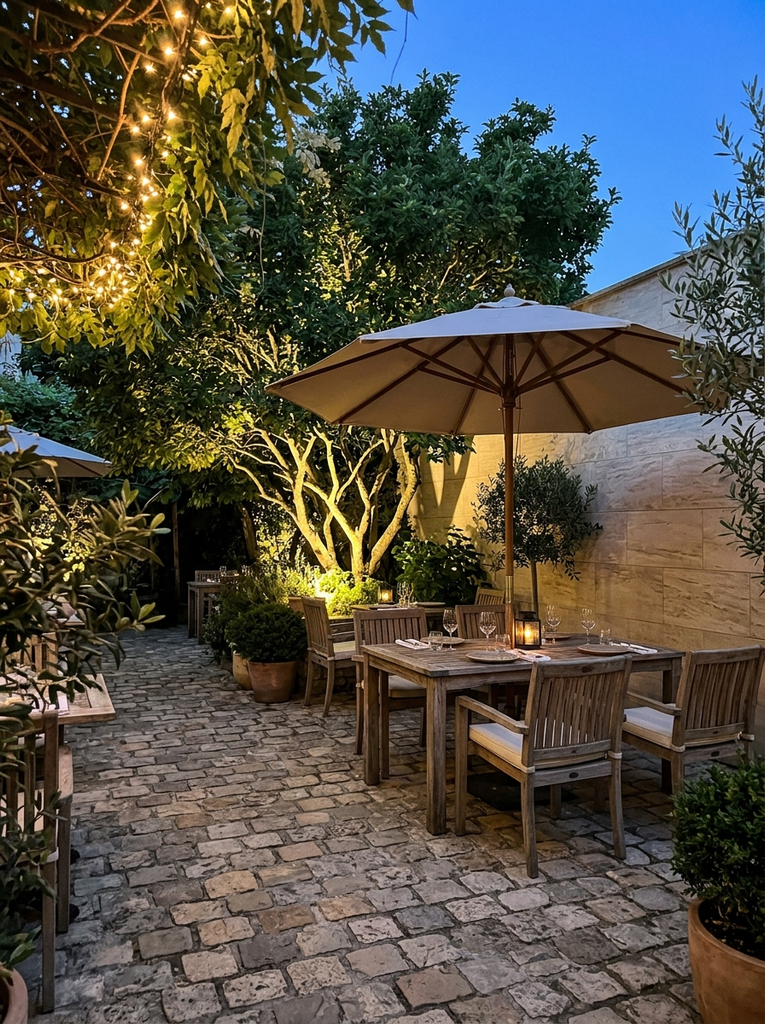
Light that hides in leaves looks like fireflies, which makes it one of the most charming backyard lighting ideas for a small patio dining area. Draw the strand through a leafy tree or climber so the bulbs peek out between the branches, then let it run along the fence line toward the table. A beige or natural umbrella works almost like a lampshade, catching the glow and bouncing a warm light down over the table. Teak chairs and a stone-colored paver floor make a neutral base that takes the light well, so there is no need for extra color. A single uplight aimed into the tree behind adds a second layer of green glow. Keep the strand close to the foliage rather than centered over the table, which makes the light feel found instead of installed.
14. Turn Planters Into Glowing Orbs
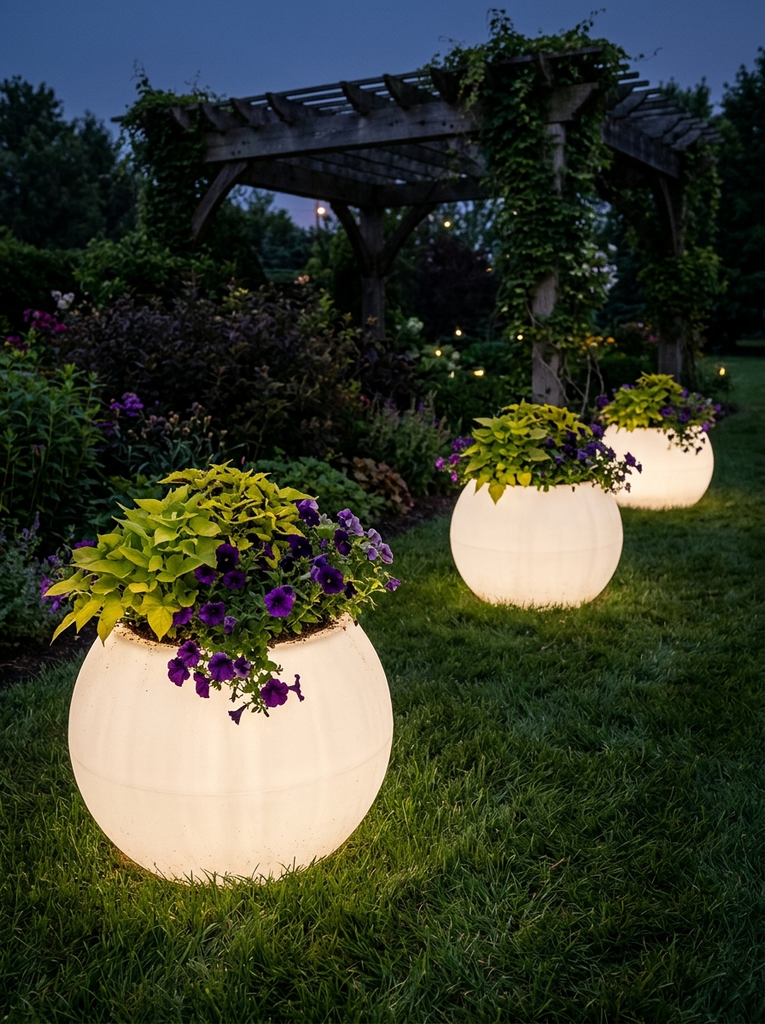
Illuminated planters look like a clever trick, and they are one of the few backyard lighting ideas that also work as sculpture in daylight. A frosted, glowing sphere filled with flowers brings the light down to ground level, where it lights petals from below and softens the bed behind it. Scatter two or three at different distances from the viewing spot rather than lining them up, since staggering creates depth. I set up a similar pair on a lawn and moved them several times before they felt right, and the spot that worked best was slightly off the sight line from the seating area, so the glow arrived as a surprise. Pick plants with soft, mounding shapes, like trailing petunias or lobelia, because stiff spiky foliage looks odd against a round glowing form. Choose rechargeable or solar models if there is no outlet nearby.
15. Dress a White Pergola With a Single Warm Strand
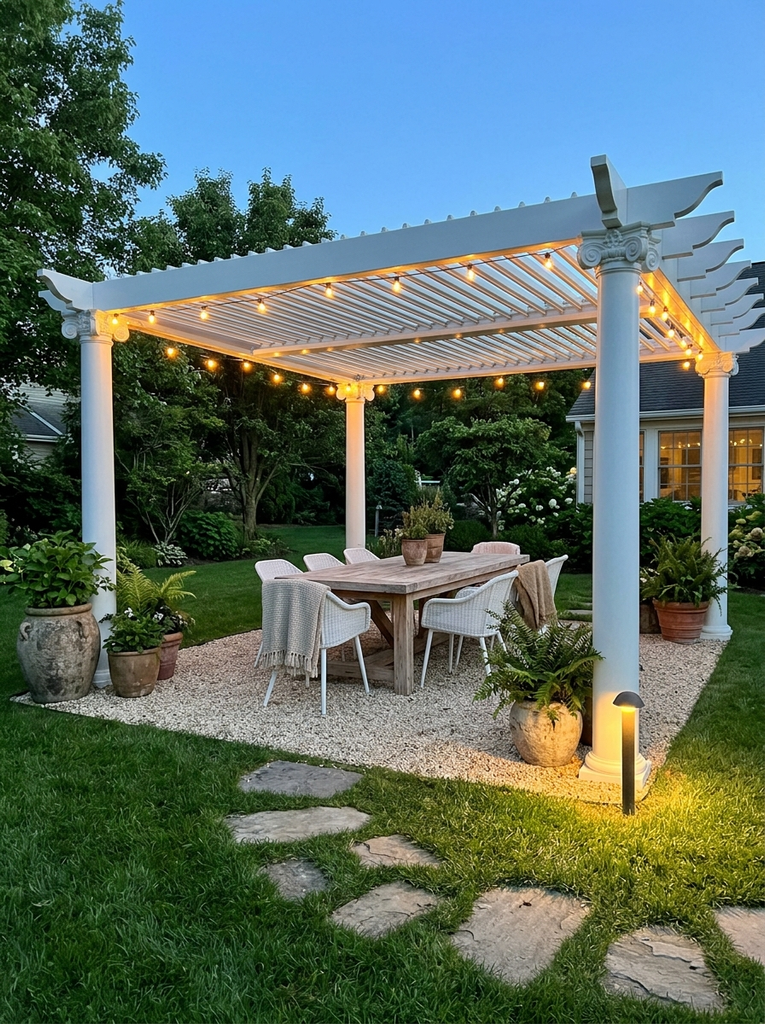
A pergola does not need dozens of fixtures, and the best backyard lighting ideas for one use almost none, because the structure already does most of the design work. One neat strand along the rafters outlines the roof, and a single path light at the corner of the dining area adds a second level. White columns and pale gravel bounce the light back, so even modest bulbs seem to glow. Woven chairs and a simple wood table in neutral tones keep the scene calm, while a pair of tall planters at the corners anchors it. Choose bulbs that match the warmth of the table wood so everything reads as one color family. If the pergola has louvers or slats, run the cable along the underside of a rafter so the strand stays tidy from every angle.
16. Pair Inset Paver Lights With Bollards
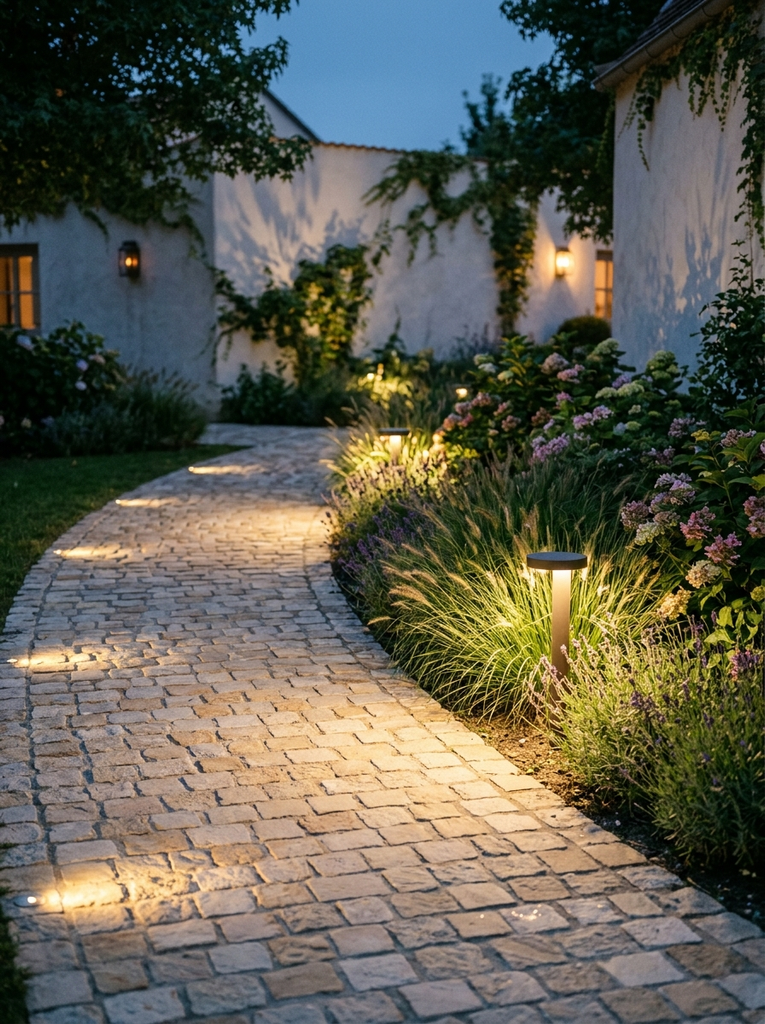
On a wide paved walkway, two kinds of light can do very different jobs, with one marking the edge and the other lighting the plants. Tiny round markers set into the paving along one side draw a dotted line that shows where the path goes, even from far away. Slim bollards at the curve of the planting bed add a taller pool of light that highlights the leaves and tells you where the bed begins. Pale stone helps, because it reflects every little glow and doubles the effect. Keep the dotted line to one side only, since two rows would make the walk feel like an airport. Space the inset lights evenly, and test the spacing with temporary stakes before anyone cuts into the pavers.
17. Wash a Wall With Up-and-Down Fixtures
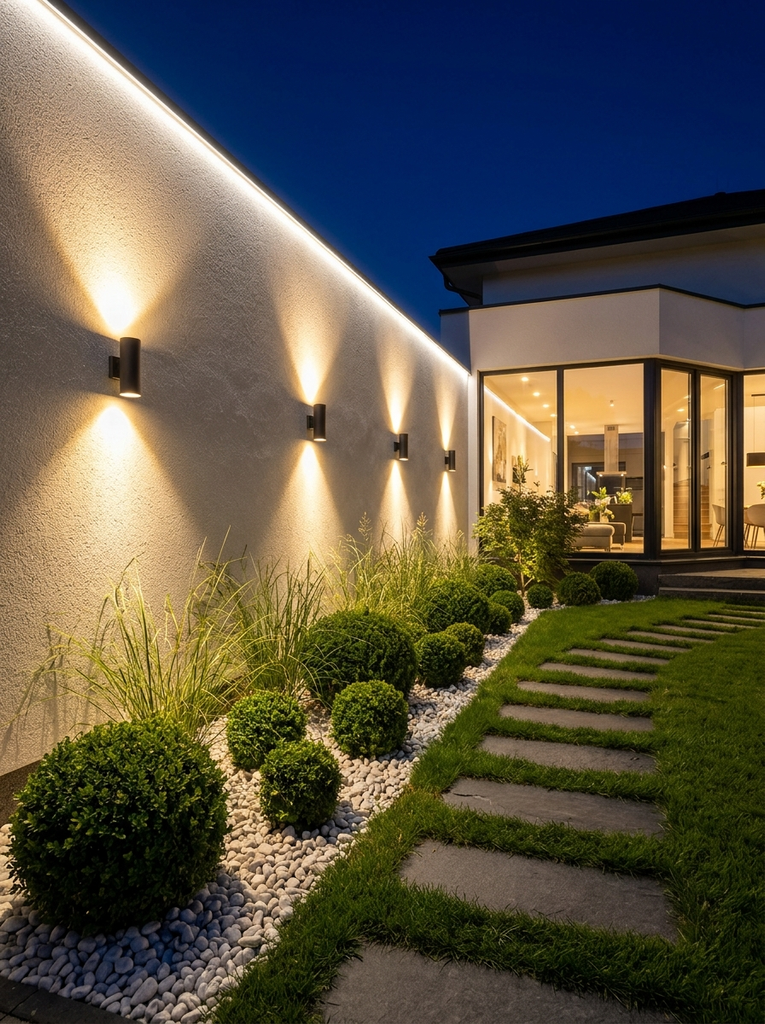
Here is the placement rule that solves the glare problem in nearly all backyard lighting ideas: put the light on the surface and hide the source from the eye. A fixture that throws light both up and down makes a pair of soft cones on a plain stucco wall, so the wall itself becomes the glow and no bare bulb faces the viewer. The same logic applies to a thin strip hidden along the top edge of the wall, which sends a clean line of light down its face. Mount fixtures above eye level so the housing shields the bulb, and aim low fixtures at the shrubs rather than outward at the path. Boxwood spheres and white pebbles at the base catch the light and give the wall a layered, sculpted look. Stepping stones set in grass lead the eye along the wall without needing a single additional fixture.
18. Create a Hammock Nook With Lanterns and Overhead Glow
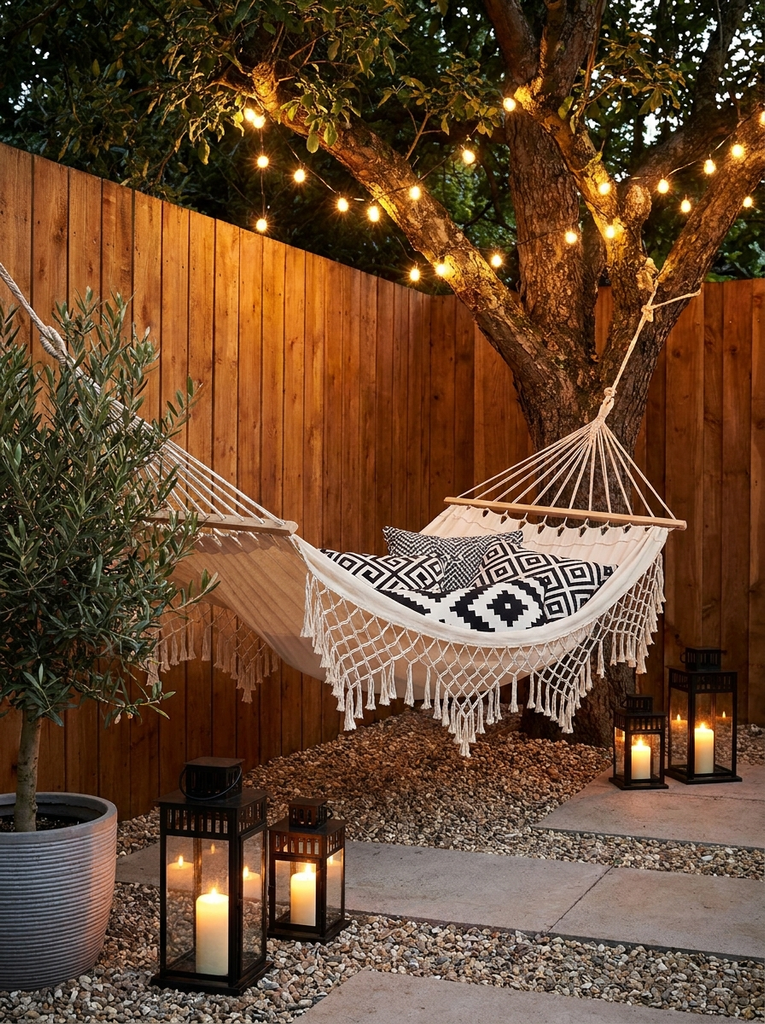
A hammock corner feels like a secret when the light is low and surrounds you, which is why it is one of the coziest backyard lighting ideas for a quiet evening. Strings of bulbs threaded through the branches overhead supply a soft canopy, while ground-level lanterns around the stand provide the glow you notice from the corner of your eye. When I styled a reading nook like this, candle-style LED lanterns at ground level worked better than adding a second overhead strand, because they kept the mood low and calm. Stepping stones and loose gravel beneath the hammock keep the area tidy and add a relaxed, casual look. A patterned throw and a couple of pillows tie the colors to the fence, so the scene feels furnished rather than empty. Use flameless lanterns near fabric, which is simply safer than a real flame.
19. Frame a Pool With Post Lights and Floor Dots
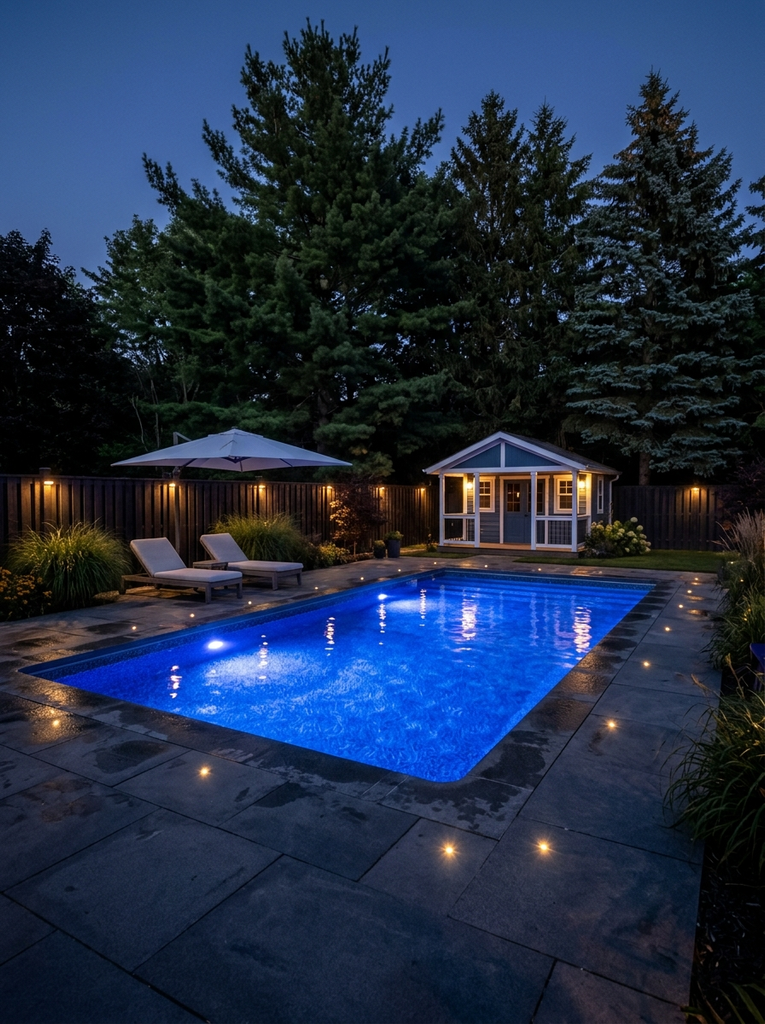
A pool at night needs light to define its edges, and the surest of the backyard lighting ideas for it is to light the fence posts and the deck rather than the water alone. Wall-mounted lights on the posts, set at an even rhythm, outline the enclosure with a warm amber glow, while tiny inset lights in the stone deck mark the walking surface. The pool itself brings the cool blue, so the warm fixtures create a satisfying temperature contrast. A shaded umbrella and lounge chairs sit in the soft zone between the two, out of direct glare. Keep fixtures well away from the water’s edge and use only products rated for wet locations, because safety matters more than style around a pool. If the pool already has an underwater light, choose a warm tone for the other fixtures to avoid a clinical, aquarium look.
20. Backlight Stone Steps With Amber Bollards
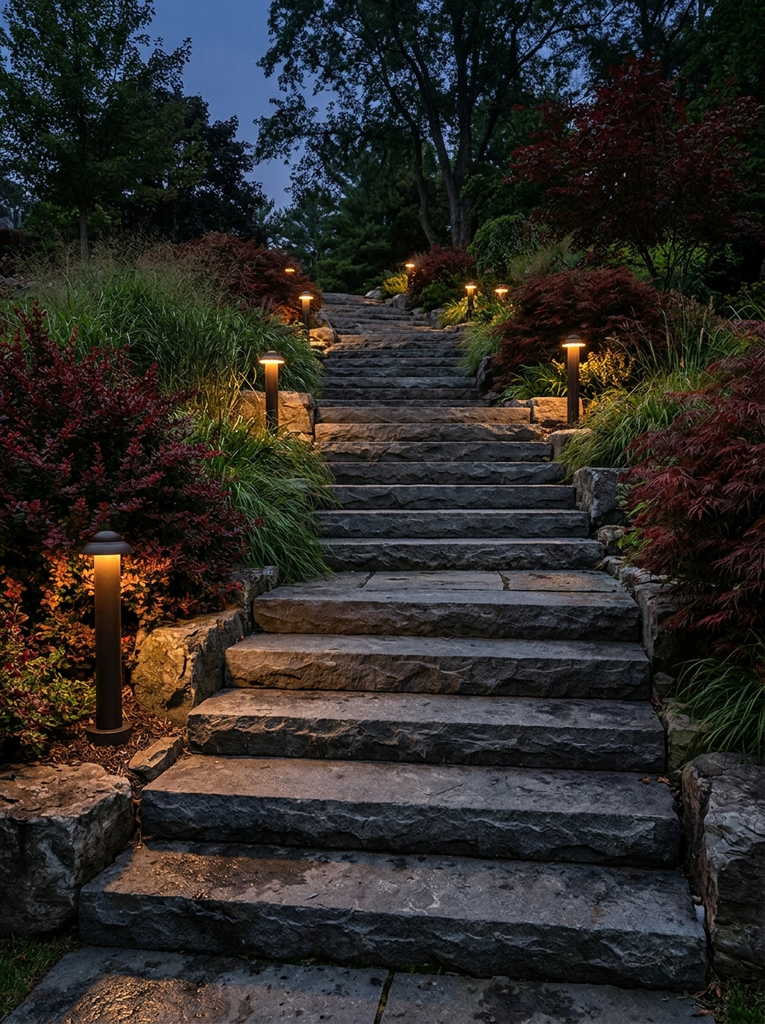
Wide stone steps can look heavy after dark, and a few amber bollards are among the simplest backyard lighting ideas for making them feel light. Set the lights at different heights in the planting beside the steps, so each one lights a patch of foliage and spills softly onto the stone. The gradient of light along the face of the steps shows each tread and makes the climb safer without a light on every riser. A warm color temperature flatters gray stone, which can look cold under cool white light. Layer tall ornamental grasses and shrubs behind the bollards so they glow like lanterns. On broad steps, put a fixture at each end and one near the middle, because three well-placed lights beat a dozen scattered ones.
Bringing It All Together
The best backyard lighting ideas share a few habits, and once you spot them, every yard becomes easier to plan. Light more than one height, with something near the ground, something at eye level and something overhead. Keep every fixture in the same warm range, hide the bulbs whenever you can, and let darkness do part of the work, because contrast is what makes a glow look rich. Start with the places people actually use, such as the steps, the table and the path. Add the decorative accents only after those basics feel right.
You do not need to use all twenty. Pick two or three backyard lighting ideas that suit your space, live with them for a few evenings and adjust before you commit to any wiring. Dimmers and timers take the guesswork out of daily use, and a small change in placement often matters more than a pricier fixture. The moment the first warm light comes on at dusk and the yard turns from a view into a place, you will know it worked.